
From Art to Fabric to Fashion: The TERRACOTTA Design Process

Updated: Sep 22

Every finished look begins long before the first stitch.
At TERRACOTTA, fashion does not always begin with a dress.
Sometimes it begins with a painting.
Sometimes with a line drawn in a sketchbook.
Sometimes with an extraordinary textile.
Sometimes with one colour that refuses to leave your mind.
The finished garment is only the visible end of a much longer creative journey.
For us, the process moves through several stages:
Art → Textile → Silhouette → Making → Complete Look
Each stage leaves something behind in the next.
That is how an idea becomes something you can wear.

Stage One: The Idea
Before fabric is cut, there has to be an idea.
We begin by asking:
What should this piece feel like?
Strong?
Romantic?
Architectural?
Playful?
Connected to place?
Designed around a particular artwork?
The answer creates direction.
Without an idea, it is easy to keep adding details.
With a clear concept, we know what belongs — and what does not.
For TERRACOTTA, this is where design begins.

Stage Two: Art
Some TERRACOTTA concepts begin with original artwork.
A painting can establish:
colour,
movement,
rhythm,
symbolism,
contrast,
and emotion.
We look at the artwork not only as an image, but as a potential surface.
Which parts could become a print?
What happens when the image repeats?
How will the scale change when it moves from canvas to fabric?
How might the artwork behave on a moving body?
Fashion gives a static image another life.

Stage Three: From Artwork to Textile
Moving from artwork to fabric changes everything.
A painting has edges.
A textile continues.
That means the design needs rhythm.
Scale becomes critical.
A motif that looks beautiful on paper may become too large on a dress.
A tiny pattern may disappear from a distance.
Placement matters too.
We consider where the strongest areas of the textile should fall:
across the bodice,
through the skirt,
along a panel,
or perhaps only in one statement section.
The textile is not just printed material.
It becomes part of the architecture of the garment.
Sometimes the Textile Comes First
Not every TERRACOTTA design begins with our own artwork.
Sometimes an existing textile is powerful enough to begin the entire process.
When we work with selected textiles sourced from Northern Territory Aboriginal-owned art centres, the artwork and textile already have their own creative origin.
The fashion design comes afterward.
In these cases, we study the existing textile carefully before deciding what silhouette should be created.
We ask:
Where should the pattern remain uninterrupted?
Which colours should become accessories?
How much structure does the textile need?
Where should we avoid adding unnecessary detail?
The fabric leads.
The garment responds.

Stage Four: Building the Silhouette
Once the textile direction is clear, we begin shaping the garment.
The silhouette determines how the textile will live on the body.
A structured bodice can create precision.
A full skirt can create movement.
A long train can introduce drama.
A shorter silhouette can feel playful and youthful.
A clean panel can give a strong print space to breathe.
This is one of the most important stages because the same textile can become completely different garments depending on proportion.
TERRACOTTA does not simply place fabric over a body.
We build a structure for the textile to inhabit.

Stage Five: Pattern, Cut and Construction
Then the design becomes physical.
Measurements are taken.
Patterns are developed.
Pieces are cut.
The garment begins to take shape.
This is also when the original idea meets reality.
Sometimes a sketch changes during construction.
A sleeve needs less volume.
A hem needs more movement.
A panel looks stronger when moved.
A detail that seemed important on paper becomes unnecessary.
Design is not finished when the sketch is finished.
Making is part of designing.

Handmade Details Change the Result
Small handmade elements can give a garment its identity.
Covered buttons.
Hand-finished edges.
Fabric flowers.
Textile details repeated in millinery.
Layered tulle.
Sculptural forms.
These elements create continuity throughout a TERRACOTTA look.
They also make each piece feel individual.
This is one of the reasons limited production is important to us.
When a garment is not being designed for mass manufacture, there is more freedom to respond to the material and refine small details along the way.

Stage Six: Building the Colour Story
When the garment is nearly complete, we return to the textile.
But this time we look for the smaller colours.
A tiny lavender detail.
A soft pink line.
Gold.
Black.
Cream.
Green.
These secondary colours can become the foundation for the accessories.
One colour may appear in:
the shoes,
the clutch,
the jewellery,
the millinery,
or a row of buttons.
The result does not need to match perfectly.
It needs to feel connected.

Stage Seven: Millinery
For racewear, the design process continues above the shoulders.
Millinery changes the entire silhouette.
It creates height.
Movement.
Balance.
Sometimes we use the same textile from the dress within the headpiece.
Sometimes we extract one secondary colour instead.
Sometimes the headpiece introduces contrast.
But it always needs a relationship with the garment.
For TERRACOTTA, millinery is never an afterthought.
It is another stage of the design.
Stage Eight: Accessories
Next come the smaller pieces.
Shoes.
Clutch.
Jewellery.
Sometimes these decisions seem minor.
They are not.
A shoe can interrupt the entire colour story.
A clutch can introduce too much texture.
Jewellery can either complete the balance or compete with the garment.
So we return to the same question:
Does this belong to the story?
If the answer is no, it does not stay.

Stage Nine: Styling
Then the person enters the process.
Hair.
Makeup.
Posture.
Movement.
Personality.
This stage matters because fashion does not exist properly until someone wears it.
A garment can look one way on a mannequin and completely different on a person.
The wearer gives it energy.
This is particularly visible in racewear, where confidence and movement become part of the final image.
Stage Ten: Photography
Photography is not simply documentation.
It becomes another stage in the life of the design.
A close-up reveals craftsmanship.
A full-length portrait shows proportion.
A movement shot shows the skirt.
A detail image can reveal the relationship between textile, button, jewellery and millinery.
For TERRACOTTA, photography becomes part of the archive of the garment.
Because long after the event ends, the image remains.


The Complete Look
By the end of the process, the final outfit may contain:
an original artwork,
a textile,
a custom silhouette,
handmade details,
millinery,
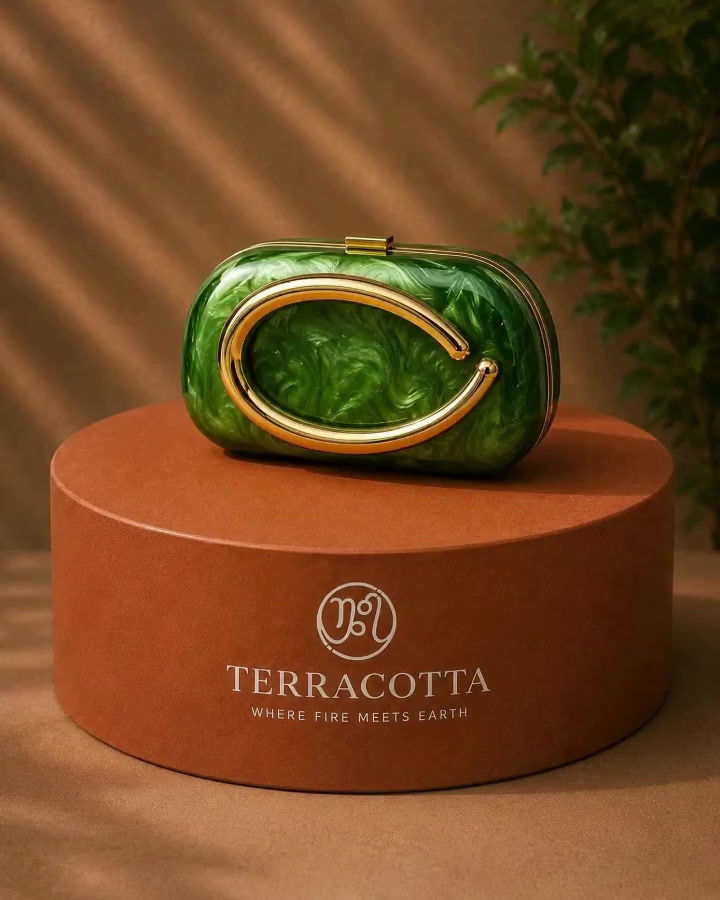
shoes,
a clutch,
jewellery,
and styling.
But the viewer should not feel the complexity.
The finished look should feel natural.
Complete.
As though every element always belonged together.
That simplicity is often the result of many decisions.

From Art to Memory
A painting becomes a textile.
A textile becomes a garment.
A garment becomes a complete look.
A complete look becomes a moment.
And sometimes that moment becomes a memory.
That is the TERRACOTTA design process.
Not simply making clothes.
But transforming an idea step by step until it becomes something that can be worn, experienced and remembered.

At TERRACOTTA, our design process is not only about creating beautiful garments.
It is also about connection, respect and collaboration.
We are proud to work with textiles connected to Aboriginal communities in the Northern Territory, including Merrepen Arts.
Through this approach, TERRACOTTA supports the visibility of Indigenous textile art, celebrates cultural storytelling through fabric, and values the creative work of community-based artists.
We also believe in working with Indigenous cotton and community-connected textile practices wherever possible, building a relationship between fashion, art and place.
For us, fabric is never just fabric.
It carries story, identity, culture and the hands of the people behind it.
That is why we do not simply use textiles as decoration.
We work with them respectfully, recognising their origin and the communities connected to them.
This is an important part of the TERRACOTTA philosophy:
fashion can be beautiful, but it can also create cultural connection, support community visibility, and honour the story behind the textile.
TERRACOTTA
Discover the TERRACOTTA Design Process →


Comments